
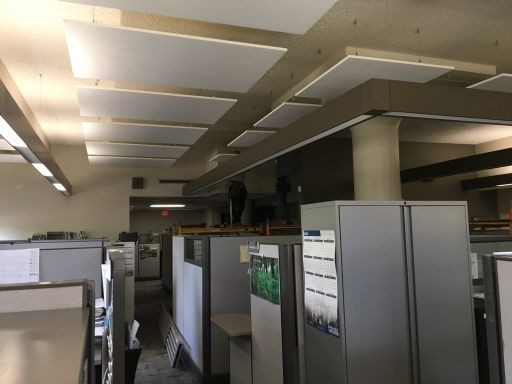
NRC ratings get thrown around in ceiling specifications without much explanation. What does the number actually change in a finished room? A panel with a 0.90 NRC rating absorbs dramatically more sound than one rated 0.55. That difference is the entire point of paying more for one over the other.
We install high NRC acoustic ceiling panels in Superior commercial spaces where standard tile has already proven insufficient. Think open offices, gymnasiums, and rooms with hard, reflective surfaces working against normal conversation. The rating is a real performance measurement, not a marketing number.
What NRC Actually Measures
Noise Reduction Coefficient averages how much sound a material absorbs across a standard set of frequencies. It’s expressed as a number between 0 and 1. A rating of 0.90 means the panel absorbs roughly 90 percent of the sound that hits it. A rating of 0.50 absorbs about half.
Most standard acoustic tile falls in the 0.50 to 0.70 range. Anything above 0.70 is generally considered high performance.
When Standard NRC Ratings Fall Short
Standard tile performs fine in a typical private office or a quiet corridor. It struggles in gymnasiums, cafeterias, and open floor plans. Any room that combines hard surfaces with a high volume of simultaneous conversation puts real strain on standard tile.
In those spaces, a jump from 0.55 to 0.85 NRC is often the difference between a room that functions and one people avoid for anything requiring focus.
How Acoustical Ceilings in Duluth, MN Use This Rating
Acoustical ceilings in Duluth, MN that commercial buildings specify are increasingly chosen by NRC target rather than brand name. That shift has made buyers more precise about what they’re actually solving for.
Specifying a number instead of a product line also keeps material options open. Several manufacturers offer panels meeting the same NRC threshold at different price points.
The Tradeoffs That Come With Higher NRC
Higher-NRC panels typically cost more. Very high ratings can occasionally make a small room feel acoustically flat rather than pleasant. Matching the rating to the room’s actual size and use matters as much as chasing the highest number available.
| NRC Range | Typical Space | What It Delivers |
| 0.50 – 0.70 | Private offices, corridors | Standard sound control |
| 0.70 – 0.85 | Open offices, classrooms | Meaningfully quieter, better speech clarity |
| 0.85 and above | Gyms, cafeterias, auditoriums | Maximum absorption for high-volume rooms |
Why We Test the Room, Not Just Recommend a Number
A room’s acoustic problem is not always solved by the ceiling alone. Hard walls and flooring can undercut even a high-NRC ceiling if they keep reflecting sound the ceiling was never going to catch.
We assess the whole room before recommending an NRC target. Installing an expensive high-performance panel into a room with other unaddressed surfaces rarely delivers the improvement a client expects.
The Number Should Match the Problem
A high NRC rating solves a specific, real problem. It cuts down reflected sound in a room that needs to function despite hard surfaces and heavy use. It is not an upgrade every room needs by default.
For every project involving high NRC acoustic ceiling panels in Superior, Schaefer Acoustics matches the rating to the room rather than defaulting to the highest number available. That approach tends to produce a better outcome than chasing a spec sheet in isolation.
Frequently Asked Questions
What NRC rating counts as high performance?
Generally, anything above 0.70 is considered high performance. Standard acoustic tile typically falls between 0.50 and 0.70 NRC.
Is a higher NRC rating always better?
Not necessarily. Very high NRC panels in a small room can make the space feel acoustically flat or unnaturally quiet. Matching the rating to room size and use matters more than maximizing the number.
Can a high-NRC ceiling fix a noisy room on its own?
Not always. Hard walls and flooring can keep reflecting sound even with an excellent ceiling. A full room assessment shows whether other surfaces need attention too.
Do high NRC panels cost significantly more than standard tile?
Generally, yes, though the difference varies by manufacturer and product line. We walk through the cost difference relative to the acoustic improvement during the estimate.
What kinds of rooms typically need high NRC panels?
Gymnasiums, cafeterias, open offices, and other high-volume spaces with hard, reflective surfaces are the most common candidates for high-NRC ceiling panels.
